 Vize
use-sorted-locale
Sort strings locale-aware with Intl.Collator.
| Package | @vizejs/composable/use-sorted-locale |
| Own the source | vize lib pull composable:use-sorted-locale |
| Runtime exports | useSortedLocale |
| Gzip budget | 2304 B |
Minimal setup
Use a Vue 3.5+ project with Vue SFC compilation configured (see Vite+ integration).
vp install @vizejs/composable
Import the entry directly. Call lifecycle-bound utilities inside <script setup> so cleanup follows the component scope; consult the runtime contract for this entry's SSR and hydration behavior.
import { useSortedLocale } from "@vizejs/composable/use-sorted-locale";
Try it
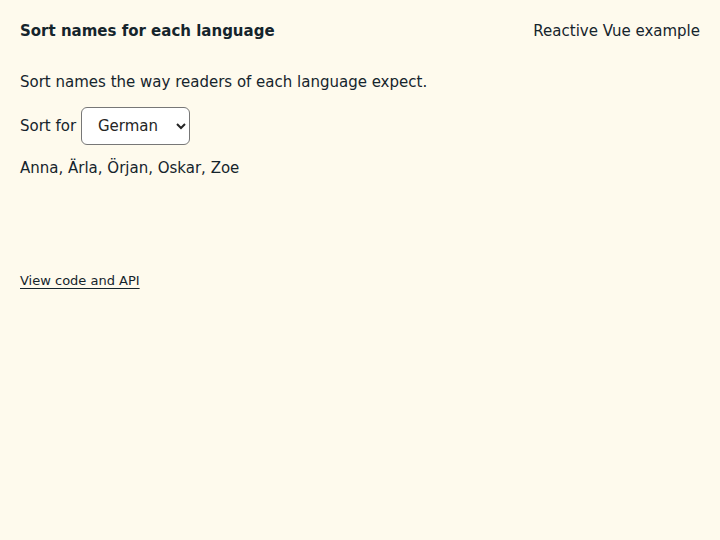
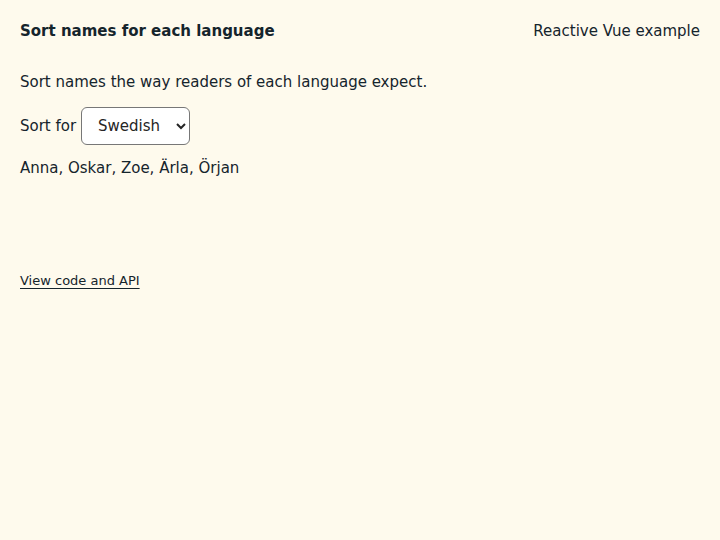
Sort names for each language
Sort strings with the reader's collation rules instead of code point order.
What to observe: German sorts Ärla and Örjan next to A and O. Choose Swedish to move them after Zoe, where Swedish readers expect Ä and Ö.
The options can be a computed ref, so changing the locale rebuilds the Intl.Collator. Pass key to sort objects by one of their fields.
Compare the initial and interacted states
Copy the example
Save this complete SFC in your Vue project. Its public imports and source are the same ones executed in the preview.
<script setup lang="ts">
import { computed, ref } from "vue";
import { useSortedLocale } from "@vizejs/composable/use-sorted-locale";

const locale = ref("de-DE");
const names = ["Zoe", "Ärla", "Anna", "Oskar", "Örjan"];
const { sorted } = useSortedLocale(
  names,
  computed(() => ({ locale: locale.value })),
);
</script>

<template>
  <div class="composable-example">
    <p>Sort names the way readers of each language expect.</p>
    <label>
      Sort for
      <select v-model="locale">
        <option value="de-DE">German</option>
        <option value="sv-SE">Swedish</option>
      </select>
    </label>
    <output aria-live="polite">{{ sorted.join(", ") }}</output>
  </div>
</template>
Runtime contract
| Utility | Category | Stability | SSR | Hydration | Cleanup | Targets | Host globals | Uses |
|---|---|---|---|---|---|---|---|---|
useSortedLocale |
i18n | experimental | deterministic-fallback | caller-managed | none | web, server, worker, native, desktop, terminal | Intl, window |
useLocale |
API
useSortedLocale
Sort strings locale-aware with Intl.Collator.
function useSortedLocale( items: MaybeRefOrGetter<readonly string[]>, options?: MaybeRefOrGetter<UseSortedLocaleOptions<string>>, ): SortedLocaleControls<string>
useSortedLocale
Sort any items locale-aware by a string key with Intl.Collator.
function useSortedLocale<Item>( items: MaybeRefOrGetter<readonly Item[]>, options: MaybeRefOrGetter< UseSortedLocaleOptions<Item> & { readonly key: (item: Item) => string } >, ): SortedLocaleControls<Item>
useSortedLocale
Sort items with locale-aware collation (Intl.Collator): "ä" sorts next to "a" in German but after "z" in Swedish, and numeric: true orders "item 10" after "item 9". The result is a new, stable-sorted array recomputed when the items, options, or locale change; the source array is never mutated. Invalid options surface as the platform RangeError. Derived state only: safe and deterministic on the server when the locale is explicit.
function useSortedLocale<Item>( items: MaybeRefOrGetter<readonly Item[]>, options: MaybeRefOrGetter<UseSortedLocaleOptions<Item>> = {}, ): SortedLocaleControls<Item>
const { sorted } = useSortedLocale(users, { key: (user) => user.name, locale: "de", sensitivity: "base" });
Types
UseSortedLocaleOptions
Options for useSortedLocale.
| Member | Type | Description |
|---|---|---|
locale? |
string | Intl.Locale |
Locale whose collation order is used. Pass it explicitly for hydration-stable server rendering. |
descending? |
boolean |
Sort from Z to A. |
key? |
(item: Item) => string |
Text to compare for each item. Required for non-string items. |
SortedLocaleControls
Reactive locale-aware sorting returned by useSortedLocale.
| Member | Type | Description |
|---|---|---|
locale |
ComputedRef<string> |
Canonical locale in use. |
collator |
ComputedRef<Intl.Collator> |
Collator for the current locale and options. |
sorted |
ComputedRef<readonly Item[]> |
New array sorted by locale collation; the source is never mutated. |
compare |
(left: string, right: string) => number |
Compare two strings with the current collator (ignores descending). |