 Vize
use-async-queue
Run async tasks one after another, each receiving the previous result.
| Package | @vizejs/composable/use-async-queue |
| Own the source | vize lib pull composable:use-async-queue |
| Runtime exports | useAsyncQueue |
| Gzip budget | 1280 B |
Minimal setup
Use a Vue 3.5+ project with Vue SFC compilation configured (see Vite+ integration).
vp install @vizejs/composable
Import the entry directly. Call lifecycle-bound utilities inside <script setup> so cleanup follows the component scope; consult the runtime contract for this entry's SSR and hydration behavior.
import { useAsyncQueue } from "@vizejs/composable/use-async-queue";
Try it
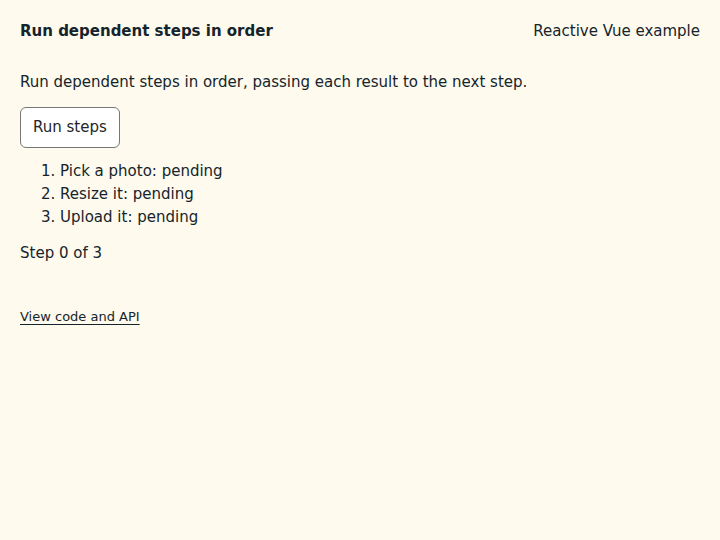
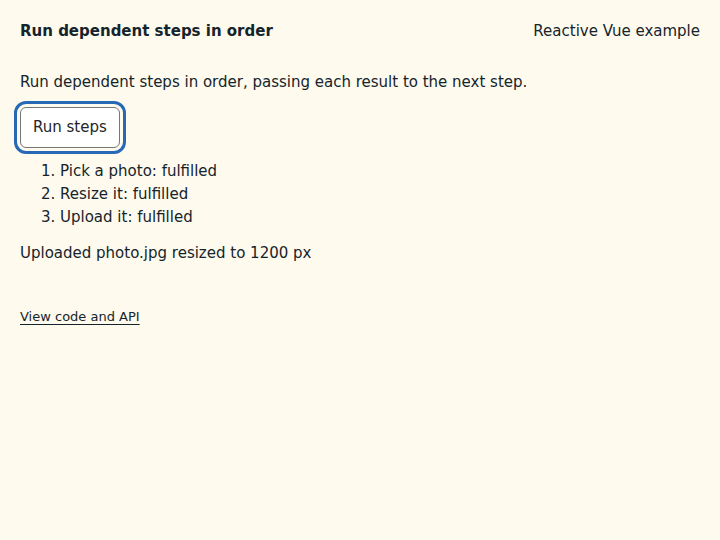
Run dependent steps in order
Run async steps one after another, passing each result to the next, and show the state of every step.
What to observe: Run steps moves each step from pending to fulfilled in order and ends with Uploaded photo.jpg resized to 1200 px.
Pass immediate: false to start with run(). With interrupt: true (the default) a failing step marks the rest as aborted.
Compare the initial and interacted states
Copy the example
Save this complete SFC in your Vue project. Its public imports and source are the same ones executed in the preview.
<script setup lang="ts">
import { computed } from "vue";
import { useAsyncQueue } from "@vizejs/composable/use-async-queue";

const { results, activeIndex, isFinished, run } = useAsyncQueue(
  [
    () => "photo.jpg",
    (file: string) => `${file} resized to 1200 px`,
    (resized: string) => `Uploaded ${resized}`,
  ],
  { immediate: false },
);
const steps = ["Pick a photo", "Resize it", "Upload it"];
const summary = computed(() =>
  isFinished.value ? String(results.value[2]?.data) : `Step ${activeIndex.value + 1} of 3`,
);
</script>

<template>
  <div class="composable-example">
    <p>Run dependent steps in order, passing each result to the next step.</p>
    <button type="button" @click="() => run()">Run steps</button>
    <ol aria-label="Steps">
      <li v-for="(step, index) in steps" :key="step">{{ step }}: {{ results[index]?.state }}</li>
    </ol>
    <output aria-live="polite">{{ summary }}</output>
  </div>
</template>
Runtime contract
| Utility | Category | Stability | SSR | Hydration | Cleanup | Targets | Host globals | Uses |
|---|---|---|---|---|---|---|---|---|
useAsyncQueue |
async | experimental | safe | stable | returned-value | web, server, worker, native, desktop, terminal | AbortController |
— |
API
useAsyncQueue
Run async tasks one after another, each receiving the previous result. Result types are inferred per position from the task tuple, and each task's previous parameter is contextually typed as the preceding task's result (up to six tasks; longer queues use the mapped-tuple signature with annotated parameters). Every task gets an AbortSignal; abort() (or the external signal) stops the queue and marks unfinished tasks "aborted". A new run() aborts the one in flight. Starts on the server too when immediate, but nothing awaits it there, so markup shows the pending state on both sides.
function useAsyncQueue<R1>( tasks: readonly [AsyncQueueTask<undefined, R1>], options?: UseAsyncQueueOptions, ): AsyncQueue<[R1]>
const { results } = useAsyncQueue([
  async () => fetchUser(),
  async (user) => fetchOrders(user.id),
]);
useAsyncQueue
function useAsyncQueue<R1, R2>( tasks: readonly [AsyncQueueTask<undefined, R1>, AsyncQueueTask<R1, R2>], options?: UseAsyncQueueOptions, ): AsyncQueue<[R1, R2]>
useAsyncQueue
function useAsyncQueue<R1, R2, R3>( tasks: readonly [AsyncQueueTask<undefined, R1>, AsyncQueueTask<R1, R2>, AsyncQueueTask<R2, R3>], options?: UseAsyncQueueOptions, ): AsyncQueue<[R1, R2, R3]>
useAsyncQueue
function useAsyncQueue<R1, R2, R3, R4>( tasks: readonly [ AsyncQueueTask<undefined, R1>, AsyncQueueTask<R1, R2>, AsyncQueueTask<R2, R3>, AsyncQueueTask<R3, R4>, ], options?: UseAsyncQueueOptions, ): AsyncQueue<[R1, R2, R3, R4]>
useAsyncQueue
function useAsyncQueue<R1, R2, R3, R4, R5>( tasks: readonly [ AsyncQueueTask<undefined, R1>, AsyncQueueTask<R1, R2>, AsyncQueueTask<R2, R3>, AsyncQueueTask<R3, R4>, AsyncQueueTask<R4, R5>, ], options?: UseAsyncQueueOptions, ): AsyncQueue<[R1, R2, R3, R4, R5]>
useAsyncQueue
function useAsyncQueue<R1, R2, R3, R4, R5, R6>( tasks: readonly [ AsyncQueueTask<undefined, R1>, AsyncQueueTask<R1, R2>, AsyncQueueTask<R2, R3>, AsyncQueueTask<R3, R4>, AsyncQueueTask<R4, R5>, AsyncQueueTask<R5, R6>, ], options?: UseAsyncQueueOptions, ): AsyncQueue<[R1, R2, R3, R4, R5, R6]>
useAsyncQueue
function useAsyncQueue<Results extends readonly unknown[]>( tasks: AsyncQueueTasks<Results>, options?: UseAsyncQueueOptions, ): AsyncQueue<Results>
useAsyncQueue
function useAsyncQueue( tasks: readonly ErasedTask[], options: UseAsyncQueueOptions = {}, ): AsyncQueue<readonly unknown[]>
Types
AsyncQueueTaskResult
Outcome record of one queued task.
| Member | Type | Description |
|---|---|---|
state |
AsyncQueueTaskState |
Current lifecycle state. |
data |
Data | undefined |
Resolved value once fulfilled. |
error |
unknown |
Failure once rejected. |
AsyncQueueContext
Context passed to every queued task.
| Member | Type | Description |
|---|---|---|
signal |
AbortSignal |
Aborted when the queue is aborted. |
UseAsyncQueueOptions
Options for useAsyncQueue.
| Member | Type | Description |
|---|---|---|
interrupt? |
boolean |
Stop at the first rejection (remaining tasks become "aborted"). |
immediate? |
boolean |
Start running right away. |
signal? |
AbortSignal |
External cancellation; aborting it aborts the queue. |
onError? |
(error: unknown, index: number) => void |
Called when a task rejects. |
onFinished? |
() => void |
Called once the queue settles. |
AsyncQueue
Queue state and controls returned by useAsyncQueue.
| Member | Type | Description |
|---|---|---|
activeIndex |
Readonly<ShallowRef<number>> |
Index of the running task (-1 before start, length when done). |
results |
Readonly< ShallowRef<{ readonly [Index in keyof Results]: AsyncQueueTaskResult<Results[Index]> }> > |
Per-task outcome records, typed per position. |
isFinished |
ComputedRef<boolean> |
Whether the queue settled (all done, interrupted, or aborted). |
run |
() => Promise<{ readonly [Index in keyof Results]: AsyncQueueTaskResult<Results[Index]>; }> |
Run the queue (again) from the first task. |
abort |
(reason?: unknown) => void |
Abort the running queue. |