 Vize
use-date-format
Format a date with a token pattern or Intl.DateTimeFormat options.
| Package | @vizejs/composable/use-date-format |
| Own the source | vize lib pull composable:use-date-format |
| Runtime exports | formatDate, useDateFormat |
| Gzip budget | 2560 B |
Minimal setup
Use a Vue 3.5+ project with Vue SFC compilation configured (see Vite+ integration).
vp install @vizejs/composable
Import the entry directly. Call lifecycle-bound utilities inside <script setup> so cleanup follows the component scope; consult the runtime contract for this entry's SSR and hydration behavior.
import { formatDate, useDateFormat } from "@vizejs/composable/use-date-format";
Try it
Show a start time in a time zone
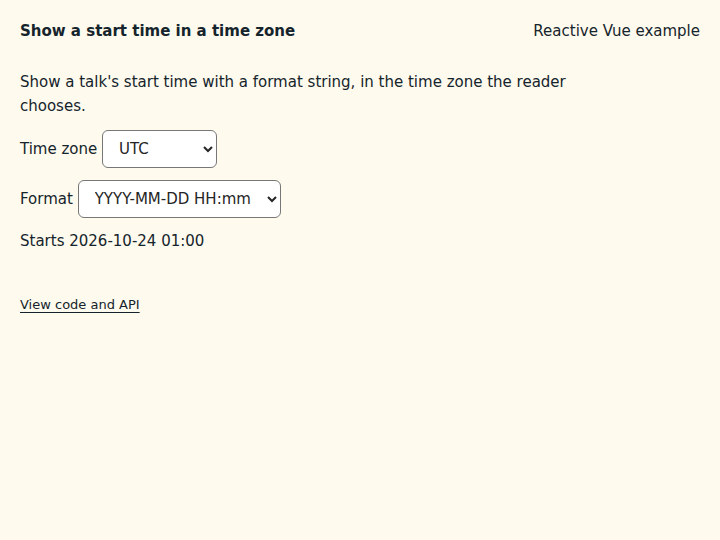
Format a timestamp with a token pattern and a reader-selected time zone.
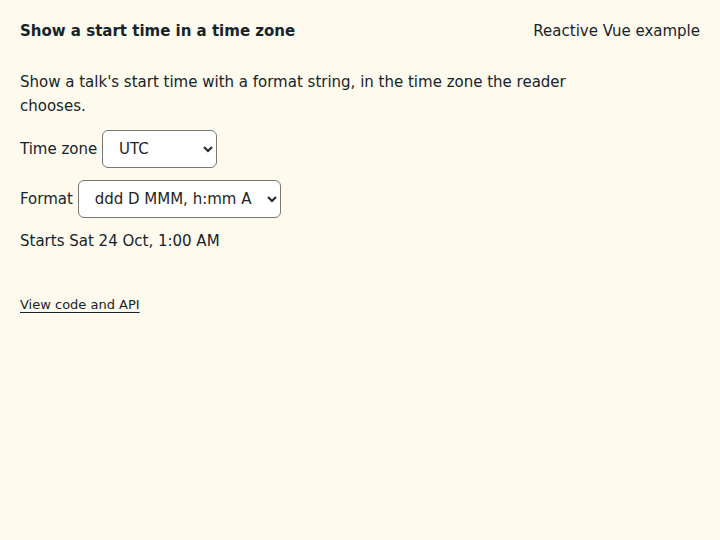
What to observe: The talk starts 2026-10-24 01:00 in UTC and 2026-10-24 10:00 in Tokyo. Switch the format to see Sat 24 Oct, 1:00 AM.
Tokens follow common date libraries (YYYY, MM, DD, HH, mm, ddd, A); wrap literal text in brackets. Both the pattern and timeZone can be refs.
Compare the initial and interacted states
Copy the example
Save this complete SFC in your Vue project. Its public imports and source are the same ones executed in the preview.
<script setup lang="ts">
import { ref } from "vue";
import { useDateFormat } from "@vizejs/composable/use-date-format";

const start = Date.UTC(2026, 9, 24, 1, 0);
const timeZone = ref("UTC");
const pattern = ref("YYYY-MM-DD HH:mm");
const formatted = useDateFormat(start, pattern, { timeZone });
</script>

<template>
  <div class="composable-example">
    <p>Show a talk's start time with a format string, in the time zone the reader chooses.</p>
    <label>
      Time zone
      <select v-model="timeZone">
        <option value="UTC">UTC</option>
        <option value="Asia/Tokyo">Tokyo</option>
        <option value="America/New_York">New York</option>
      </select>
    </label>
    <label>
      Format
      <select v-model="pattern">
        <option value="YYYY-MM-DD HH:mm">YYYY-MM-DD HH:mm</option>
        <option value="ddd D MMM, h:mm A">ddd D MMM, h:mm A</option>
      </select>
    </label>
    <output aria-live="polite">Starts {{ formatted }}</output>
  </div>
</template>
Runtime contract
| Utility | Category | Stability | SSR | Hydration | Cleanup | Targets | Host globals | Uses |
|---|---|---|---|---|---|---|---|---|
formatDate |
i18n | experimental | safe | stable | none | web, server, worker, native, desktop, terminal | Intl |
— |
useDateFormat |
i18n | experimental | safe | stable | none | web, server, worker, native, desktop, terminal | Intl |
formatDate |
API
formatDate
Format a date with a token pattern or Intl.DateTimeFormat options. Pure and deterministic: locale and time zone default to fixed values ("en", "UTC") rather than host settings, so the same input renders identically on server and client. Calendar fields are computed in the requested time zone through Intl, so no host-zone arithmetic leaks in.
function formatDate( input: DateFormatInput, format: string | Intl.DateTimeFormatOptions = "HH:mm:ss", options: FormatDateOptions = {}, ): string
formatDate(0, "YYYY-MM-DD HH:mm:ss"); // "1970-01-01 00:00:00"
formatDate(0, "dddd, MMMM D [at] h:mm A", { locale: "en", timeZone: "Asia/Tokyo" });
formatDate(0, { dateStyle: "long" }, { locale: "ja" }); // "1970年1月1日"
useDateFormat
Reactive formatted date. Wraps formatDate in a computed ref; the date, the format, the locale, and the time zone are all reactive. Deterministic defaults ("en", "UTC") keep server and client output identical. No timers, no globals, nothing to dispose.
function useDateFormat( input: MaybeRefOrGetter<DateFormatInput>, format: MaybeRefOrGetter<string | Intl.DateTimeFormatOptions> = "HH:mm:ss", options: UseDateFormatOptions = {}, ): ComputedRef<string>
const label = useDateFormat(() => event.value.startsAt, "ddd, MMM D HH:mm", {
  locale: () => locale.value,
  timeZone: "Europe/Paris",
});
Types
FormatDateOptions
Options for formatDate.
| Member | Type | Description |
|---|---|---|
locale? |
string | readonly string[] |
BCP 47 locale(s) for names and Intl option formats. Defaults to a fixed locale (not the host default) so server and client output agree. |
timeZone? |
string |
IANA time zone the date is rendered in. Defaults to UTC (not the host zone) for SSR determinism; pass the user's zone explicitly. |
UseDateFormatOptions
Options for useDateFormat.
| Member | Type | Description |
|---|---|---|
locale? |
MaybeRefOrGetter<string | readonly string[]> |
Reactive BCP 47 locale(s). |
timeZone? |
MaybeRefOrGetter<string> |
Reactive IANA time zone. |