 Vize
use-display-names
Localized names of languages, regions, scripts, currencies, calendars, and date-time fields (Intl.DisplayNames): "JP" → "Japan", "ja" → "日本語" in Japanese, "EUR" → "Euro".
| Package | @vizejs/composable/use-display-names |
| Own the source | vize lib pull composable:use-display-names |
| Runtime exports | useDisplayNames |
| Gzip budget | 2304 B |
Minimal setup
Use a Vue 3.5+ project with Vue SFC compilation configured (see Vite+ integration).
vp install @vizejs/composable
Import the entry directly. Call lifecycle-bound utilities inside <script setup> so cleanup follows the component scope; consult the runtime contract for this entry's SSR and hydration behavior.
import { useDisplayNames } from "@vizejs/composable/use-display-names";
Try it
Name a language
Show a language, region or currency name in the reader's language instead of a code.
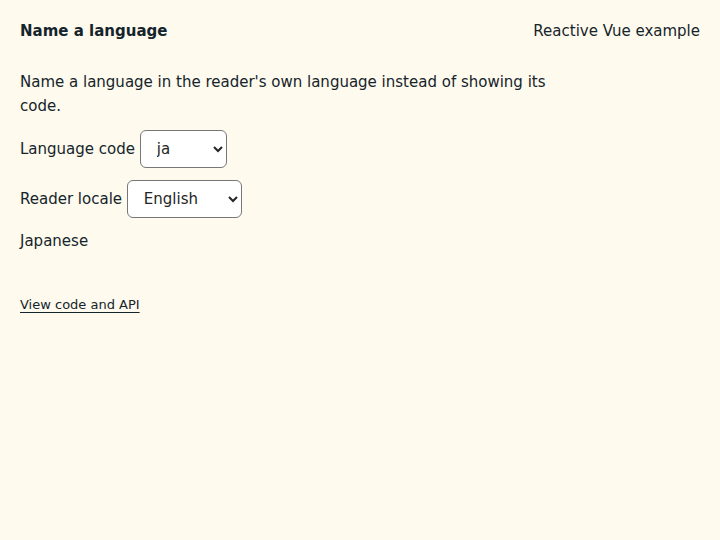
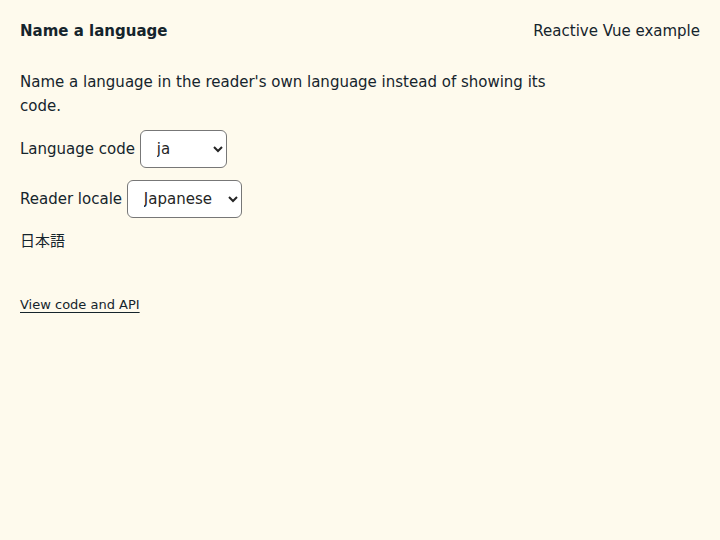
What to observe: The code ja reads Japanese in English, Japanisch in German and 日本語 in Japanese. Try fr and pt-BR.
Set type to language, region, script or currency. of() formats any code on demand.
Compare the initial and interacted states
Copy the example
Save this complete SFC in your Vue project. Its public imports and source are the same ones executed in the preview.
<script setup lang="ts">
import { computed, ref } from "vue";
import { useDisplayNames } from "@vizejs/composable/use-display-names";

const locale = ref("en");
const code = ref("ja");
const { name } = useDisplayNames(
  code,
  computed(() => ({ type: "language" as const, locale: locale.value })),
);
</script>

<template>
  <div class="composable-example">
    <p>Name a language in the reader's own language instead of showing its code.</p>
    <label>
      Language code
      <select v-model="code">
        <option value="ja">ja</option>
        <option value="fr">fr</option>
        <option value="pt-BR">pt-BR</option>
      </select>
    </label>
    <label>
      Reader locale
      <select v-model="locale">
        <option value="en">English</option>
        <option value="de">German</option>
        <option value="ja">Japanese</option>
      </select>
    </label>
    <output aria-live="polite">{{ name }}</output>
  </div>
</template>
Runtime contract
| Utility | Category | Stability | SSR | Hydration | Cleanup | Targets | Host globals | Uses |
|---|---|---|---|---|---|---|---|---|
useDisplayNames |
i18n | experimental | deterministic-fallback | caller-managed | none | web, server, worker, native, desktop, terminal | Intl, window |
useLocale |
API
useDisplayNames
Localized names of languages, regions, scripts, currencies, calendars, and date-time fields (Intl.DisplayNames): "JP" → "Japan", "ja" → "日本語" in Japanese, "EUR" → "Euro". Malformed codes yield undefined rather than the platform RangeError, so user-entered codes never crash rendering; invalid options still throw on first read. Derived state only: no listeners or timers, and deterministic during server rendering when the locale is explicit.
function useDisplayNames( code: MaybeRefOrGetter<string | null | undefined>, options: MaybeRefOrGetter<UseDisplayNamesOptions>, ): DisplayNamesControls
const { name } = useDisplayNames(regionCode, { type: "region", locale: "en" });
Types
UseDisplayNamesOptions
Options for useDisplayNames.
| Member | Type | Description |
|---|---|---|
type |
DisplayNamesKind |
Kind of code to name. |
locale? |
string | Intl.Locale |
Locale the names are written in. Pass it explicitly for hydration-stable server rendering. |
style? |
"narrow" | "short" | "long" |
Name length. |
fallback? |
"code" | "none" |
What to return for a well-formed code without a name: the code itself or undefined. |
languageDisplay? |
"dialect" | "standard" |
Language names: "dialect" names "en-GB" "British English", "standard" names it "English (United Kingdom)". |
DisplayNamesControls
Reactive display names returned by useDisplayNames.
| Member | Type | Description |
|---|---|---|
locale |
ComputedRef<string> |
Canonical locale in use. |
displayNames |
ComputedRef<Intl.DisplayNames> |
Display names instance for the current locale and options. |
name |
ComputedRef<string | undefined> |
Name of the reactive code; undefined for malformed or unnamed codes. |
of |
(code: string) => string | undefined |
Name any code. Malformed codes return undefined instead of throwing. |