 Vize
use-memoize
Cache a function's results per argument list.
| Package | @vizejs/composable/use-memoize |
| Own the source | vize lib pull composable:use-memoize |
| Runtime exports | useMemoize |
| Gzip budget | 512 B |
Minimal setup
Use a Vue 3.5+ project with Vue SFC compilation configured (see Vite+ integration).
vp install @vizejs/composable
Import the entry directly. Call lifecycle-bound utilities inside <script setup> so cleanup follows the component scope; consult the runtime contract for this entry's SSR and hydration behavior.
import { useMemoize } from "@vizejs/composable/use-memoize";
Try it
Reuse a shipping quote
Cache the result of an expensive calculation per argument and reuse it on the next call.
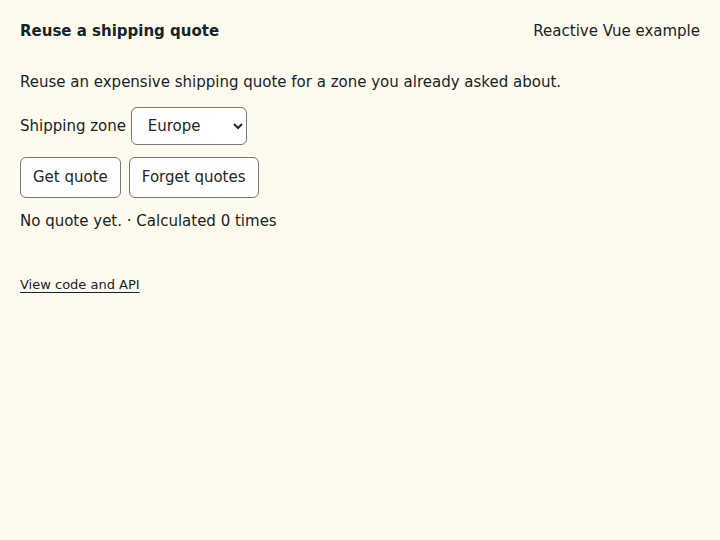
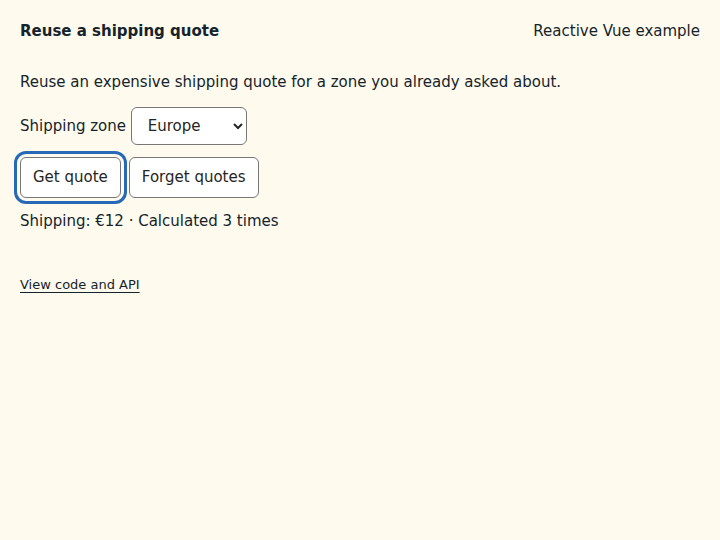
What to observe: Get quote for Europe calculates once; asking again keeps Calculated 1 times. Asia adds a calculation; Forget quotes clears the cache so Europe is calculated again.
getKey turns arguments into a cache key. The memoized function also exposes load, delete and clear. Call it from an event handler, not from the template.
Compare the initial and interacted states
Copy the example
Save this complete SFC in your Vue project. Its public imports and source are the same ones executed in the preview.
<script setup lang="ts">
import { ref } from "vue";
import { useMemoize } from "@vizejs/composable/use-memoize";

const calculations = ref(0);
const quote = useMemoize(
  (zone: string) => {
    calculations.value += 1;
    return zone === "Europe" ? 12 : zone === "Asia" ? 18 : 25;
  },
  { getKey: (zone: string) => zone },
);
const zone = ref("Europe");
const price = ref<number>();

function getQuote() {
  price.value = quote(zone.value);
}
</script>

<template>
  <div class="composable-example">
    <p>Reuse an expensive shipping quote for a zone you already asked about.</p>
    <label>
      Shipping zone
      <select v-model="zone">
        <option>Europe</option>
        <option>Asia</option>
        <option>Americas</option>
      </select>
    </label>
    <div class="example-actions">
      <button type="button" @click="getQuote">Get quote</button>
      <button type="button" @click="() => quote.clear()">Forget quotes</button>
    </div>
    <output aria-live="polite"
      >{{ price === undefined ? "No quote yet." : `Shipping: €${price}` }} · Calculated
      {{ calculations }} times</output
    >
  </div>
</template>
Runtime contract
| Utility | Category | Stability | SSR | Hydration | Cleanup | Targets | Host globals | Uses |
|---|---|---|---|---|---|---|---|---|
useMemoize |
performance | experimental | safe | stable | returned-value | web, server, worker, native, desktop, terminal | — | — |
API
useMemoize
Cache a function's results per argument list. The default cache is a reactive Map, so computeds and templates that read a memoized value re-evaluate after load, delete, or clear. Promise-returning resolvers cache the promise itself, which deduplicates concurrent requests. Keys default to JSON.stringify(args) (a string); a custom getKey sets the key type, and a custom cache must use that key type. On the server keep memoized caches request-local (create them in setup), since a module-level cache is shared across requests.
function useMemoize<Arguments extends readonly unknown[], Result, Key>( resolver: (...args: Arguments) => Result, options: UseMemoizeOptions<Arguments, Key, Result> & { readonly getKey: (...args: Arguments) => Key; }, ): Memoized<Arguments, Result, Key>
const getUser = useMemoize((id: string) => fetchUser(id), { getKey: (id) => id });
const user = computed(() => getUser(props.id));
getUser.load(props.id); // refresh
useMemoize
function useMemoize<Arguments extends readonly unknown[], Result>( resolver: (...args: Arguments) => Result, options?: UseMemoizeOptions<Arguments, string, Result>, ): Memoized<Arguments, Result, string>
useMemoize
function useMemoize( resolver: (...args: readonly unknown[]) => unknown, options: UseMemoizeOptions<readonly unknown[], unknown, unknown> = {}, ): Memoized<readonly unknown[], unknown, unknown>
Types
MemoizeCache
Minimal cache contract used by useMemoize; a Map satisfies it.
| Member | Type | Description |
|---|---|---|
get |
(key: Key) => Result | undefined |
Read a cached result. |
set |
(key: Key, value: Result) => unknown |
Store a result. |
has |
(key: Key) => boolean |
Whether a result is cached for key. |
delete |
(key: Key) => unknown |
Drop one result. |
clear |
() => void |
Drop every result. |
UseMemoizeOptions
Options for useMemoize.
| Member | Type | Description |
|---|---|---|
getKey? |
(...args: Arguments) => Key |
Derive the cache key from the arguments. |
cache? |
MemoizeCache<Key, Result> |
Storage for results; supply an LRU or a persistent cache here. |
Memoized
Memoized function returned by useMemoize.
| Member | Type | Description |
|---|---|---|
load |
(...args: Arguments) => Result |
Recompute and re-cache the result for these arguments. |
delete |
(...args: Arguments) => void |
Drop the cached result for these arguments. |
clear |
() => void |
Drop every cached result. |
generateKey |
(...args: Arguments) => Key |
Cache key for these arguments. |
cache |
MemoizeCache<Key, Result> |
The underlying cache. |