 Vize
use-request-idle-callback
Run a callback in the next idle period with requestIdleCallback.
| Package | @vizejs/composable/use-request-idle-callback |
| Own the source | vize lib pull composable:use-request-idle-callback |
| Runtime exports | idle, useRequestIdleCallback |
| Gzip budget | 2304 B |
Minimal setup
Use a Vue 3.5+ project with Vue SFC compilation configured (see Vite+ integration).
vp install @vizejs/composable
Import the entry directly. Call lifecycle-bound utilities inside <script setup> so cleanup follows the component scope; consult the runtime contract for this entry's SSR and hydration behavior.
import { idle, useRequestIdleCallback } from "@vizejs/composable/use-request-idle-callback";
Try it
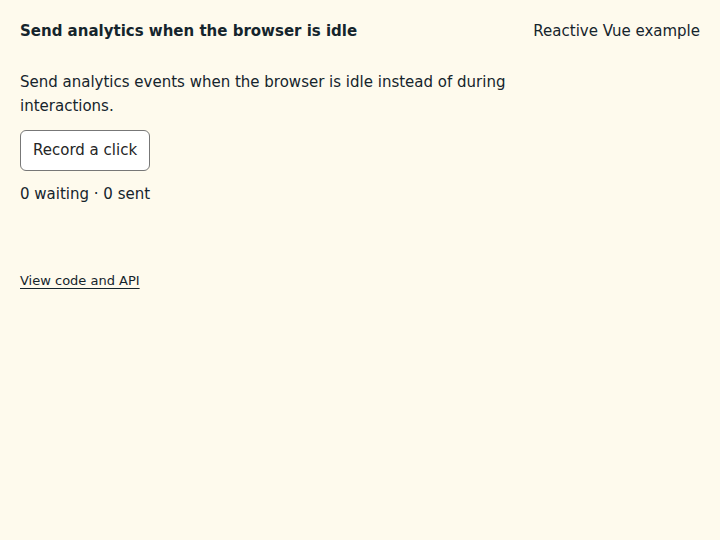
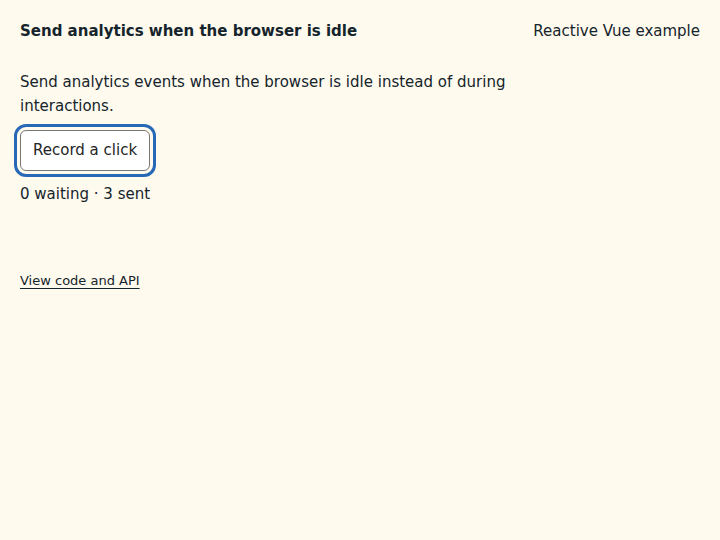
Send analytics when the browser is idle
Defer low-priority work until the browser has nothing else to do.
What to observe: Record a click three times queues three events; they are sent together once the browser is idle.
start() schedules the callback once; calling it again while pending does nothing. A timer fallback is used where requestIdleCallback is missing.
Compare the initial and interacted states
Copy the example
Save this complete SFC in your Vue project. Its public imports and source are the same ones executed in the preview.
<script setup lang="ts">
import { ref } from "vue";
import { useRequestIdleCallback } from "@vizejs/composable/use-request-idle-callback";

const queued = ref(0);
const sent = ref(0);
const { isPending, start } = useRequestIdleCallback(
  () => {
    sent.value += queued.value;
    queued.value = 0;
  },
  { immediate: false },
);

function track() {
  queued.value += 1;
  start();
}
</script>

<template>
  <div class="composable-example">
    <p>Send analytics events when the browser is idle instead of during interactions.</p>
    <button type="button" @click="track">Record a click</button>
    <output aria-live="polite"
      >{{ queued }} waiting · {{ sent }} sent{{ isPending ? " · flush scheduled" : "" }}</output
    >
  </div>
</template>
Runtime contract
| Utility | Category | Stability | SSR | Hydration | Cleanup | Targets | Host globals | Uses |
|---|---|---|---|---|---|---|---|---|
useRequestIdleCallback |
timing | experimental | deterministic-fallback | caller-managed | caller, reactive-scope | web, desktop | window |
tryOnScopeDispose |
idle |
timing | experimental | deterministic-fallback | not-applicable | caller | web, desktop | window |
— |
API
useRequestIdleCallback
Run a callback in the next idle period with requestIdleCallback. When the API is missing, a setTimeout fallback fabricates a deadline with a 50 ms budget and didTimeout: false. The pending callback is cancelled when the owning reactive scope stops; outside a scope the caller owns cancel(). Server rendering: nothing is scheduled, isPending and supported are false. Inside a component the first callback is scheduled after mounting, so hydration renders the server state first.
function useRequestIdleCallback( callback: (deadline: IdleDeadlineLike) => void, options: UseRequestIdleCallbackOptions = {}, ): RequestIdleCallbackControls
const { start } = useRequestIdleCallback((deadline) => {
  while (deadline.timeRemaining() > 1 && queue.length) queue.shift()?.();
}, { timeout: 2000, immediate: false });
idle
Resolve in the next idle period (or after timeout). Uses the same hosts and fallback as useRequestIdleCallback. When neither an idle host nor timers resolve (server rendering) it resolves on the next microtask with an exhausted deadline instead of hanging.
function idle(options: IdleOptions = {}): Promise<IdleDeadlineLike>
await idle({ timeout: 1000 });
Types
IdleDeadlineLike
Deadline handed to idle callbacks.
| Member | Type | Description |
|---|---|---|
didTimeout |
boolean |
Whether the callback runs because its timeout elapsed. |
timeRemaining |
() => number |
Milliseconds left in the current idle period. |
IdleCallbackHost
Minimal requestIdleCallback capability.
| Member | Type | Description |
|---|---|---|
requestIdleCallback |
(callback: (deadline: IdleDeadlineLike) => void, options?: { readonly timeout?: number }) => number |
Schedule callback for the next idle period. |
cancelIdleCallback |
(handle: number) => void |
Cancel a scheduled callback. |
IdleSchedulingOptions
Scheduling options shared by useRequestIdleCallback and idle.
| Member | Type | Description |
|---|---|---|
host? |
MaybeRefOrGetter<IdleCallbackHost | null | undefined> |
requestIdleCallback capability for alternate runtimes and tests. |
timers? |
MaybeRefOrGetter<TimeoutScheduler | null | undefined> |
Timers used by the fallback when host is missing. Without timers (server rendering) nothing is scheduled. |
timeout? |
number |
Run the callback after this many milliseconds even when the browser is never idle (deadline.didTimeout is then true). |
now? |
() => number |
Clock used by the fallback deadline, in milliseconds. |
UseRequestIdleCallbackOptions
Options for useRequestIdleCallback.
| Member | Type | Description |
|---|---|---|
host? |
MaybeRefOrGetter<IdleCallbackHost | null | undefined> |
requestIdleCallback capability for alternate runtimes and tests. |
timers? |
MaybeRefOrGetter<TimeoutScheduler | null | undefined> |
Timers used by the fallback when host is missing. Without timers (server rendering) nothing is scheduled. |
timeout? |
number |
Run the callback after this many milliseconds even when the browser is never idle (deadline.didTimeout is then true). |
now? |
() => number |
Clock used by the fallback deadline, in milliseconds. |
immediate? |
boolean |
Schedule the callback as soon as the composable is created. |
IdleOptions
Options for idle.
| Member | Type | Description |
|---|---|---|
host? |
MaybeRefOrGetter<IdleCallbackHost | null | undefined> |
requestIdleCallback capability for alternate runtimes and tests. |
timers? |
MaybeRefOrGetter<TimeoutScheduler | null | undefined> |
Timers used by the fallback when host is missing. Without timers (server rendering) nothing is scheduled. |
timeout? |
number |
Run the callback after this many milliseconds even when the browser is never idle (deadline.didTimeout is then true). |
now? |
() => number |
Clock used by the fallback deadline, in milliseconds. |
signal? |
AbortSignal |
Cancels the wait; the promise rejects with signal.reason. |
RequestIdleCallbackControls
Reactive state and actions returned by useRequestIdleCallback.
| Member | Type | Description |
|---|---|---|
supported |
ComputedRef<boolean> |
Whether the native requestIdleCallback API is available. |
isPending |
Readonly<ShallowRef<boolean>> |
Whether a callback is scheduled and has not run yet. |
start |
() => void |
Schedule the callback, replacing a pending one. No-op on the server. |
cancel |
() => void |
Cancel the pending callback. Repeated calls are safe. |